UK Political-Impact Tracker: Week #2
Andy Burnham, Kemi Badenoch, Shabana Mahmood, Zack Polanski and Ed Davey appear across both boards this week, reflecting simultaneous gains and setbacks.

.
Week #2: 21–27 September 2026
🔍 WHY THIS STORY MATTERS
Our UK Political-Impact Tracker, released every Sunday, tracks key developments involving politicians and influential figures like business leaders, trade-union leaders, campaigners, journalists, and academics shaping UK political debate. Events are ranked by significance: positive points for favourable developments, negative for adverse ones. These scores contribute to a Political-Impact Table. The scores don’t judge politicians’ quality or policies but reflect the balance of notable favourable and adverse events related to them.
KEY TAKEAWAYS...
● Andy Burnham and Shabana Mahmood appear on both boards this week.
● Polling and seat projections contribute to movements involving Labour, Reform UK, the Conservatives, Greens, SNP and Plaid Cymru.
P olitical weeks are often judged through headlines, polling snapshots or partisan claims about who is supposedly “winning”. The Europeans TODAY UK Political-Impact Tracker takes a different approach. Every week, we review key developments involving politicians and influential figures in the UK, including business leaders, campaigners, journalists, and academics. We rank these events by their political significance: favourable ones earn +10 to +1 points, adverse ones -10 to −1. These scores are added to a Political-Impact Table, reflecting the balance of positive and negative developments, not judgement of individuals or policies.
Week #2 — Political Gains
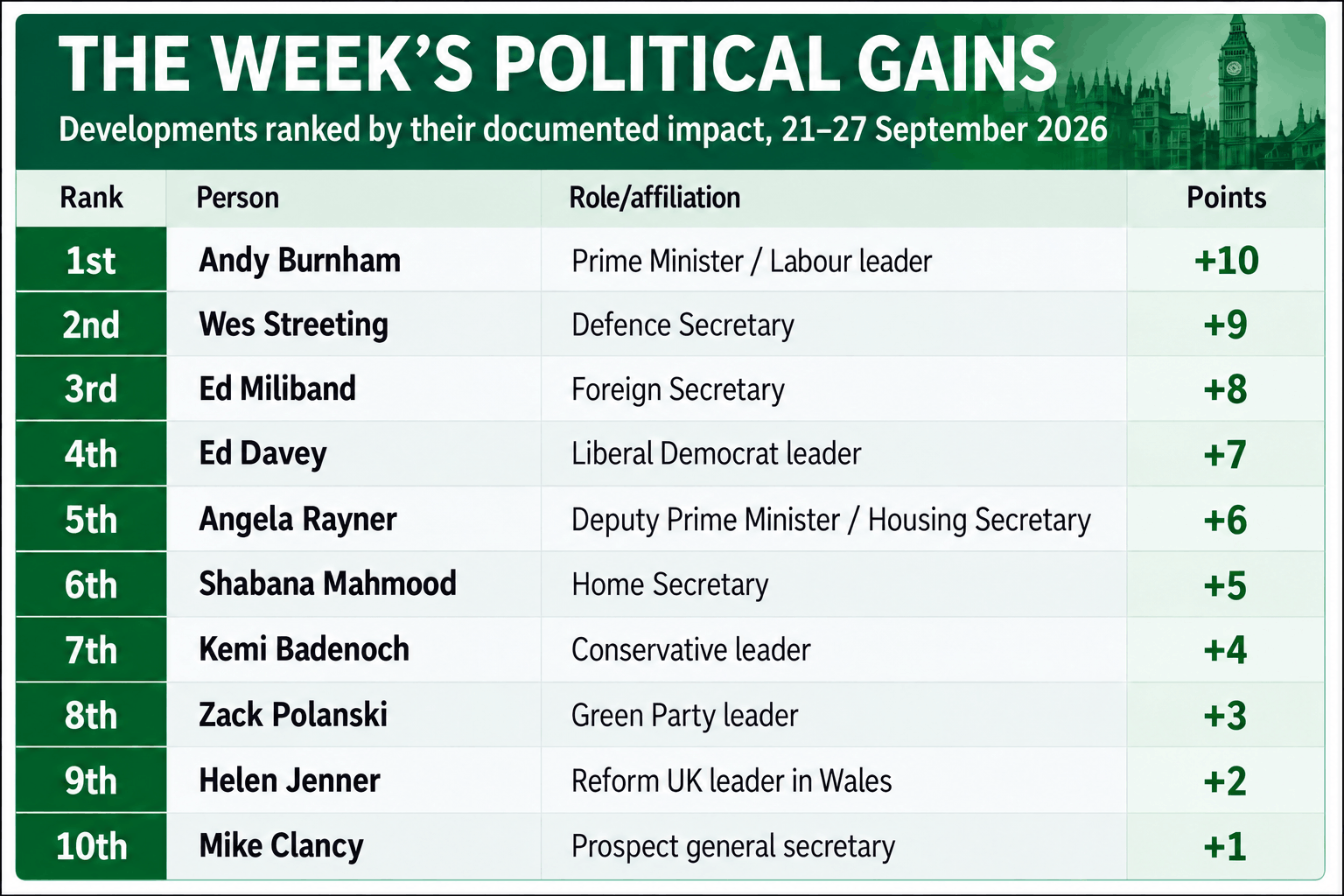
10pts — Andy Burnham
More in Common’s September MRP shifted Labour from 110 projected seats in July to 250, while Reform fell from 293 to 147. Opinium also had Labour at 28% (+1), while Burnham remained the only major leader with positive approval.
9pts — Wes Streeting
A defence industry agreement targets 40,000 youth work and training opportunities annually by 2030, rising to 50,000 by 2035. The RAF also launched its first dedicated Space Effects Squadron.
8pts — Ed Miliband
The government announced a ban on trade in goods from illegal Israeli settlements and sanctions connected with settlement construction, marking a substantive change in UK policy.
7pts — Ed Davey
The Liberal Democrat conference produced a headline £17bn income-tax-cut proposal, including raising the personal allowance to £15,000. It remains a proposal rather than implemented policy.
6pts — Angela Rayner
Her department announced a £210m high-street regeneration package, including a £125m Derelict Buildings Fund.
5pts — Shabana Mahmood
She announced new refugee resettlement routes prioritising vulnerable Afghan women and girls and Palestinians.
4pts — Kemi Badenoch
YouGov put the Conservatives at 21% (+1), level with Reform. More in Common’s MRP projected 125 Conservative seats, up 29 from July.
Zack Polanski, Helen Jenner and Mike Clancy complete the gains board
YouGov recorded the Green Party at 14%, up three points, a substantial weekly polling movement. (Zack Polanski, 3pts)
Helen Jenner has become Reform UK’s new leader in Wales following the previous leader’s resignation. (Helen Jenner, 2pts)
Prospect became part of the major defence-sector agreement expanding apprenticeships, jobs and training opportunities for young people. (Mike Clancy, 1pt)
Week #2 — Political Setbacks
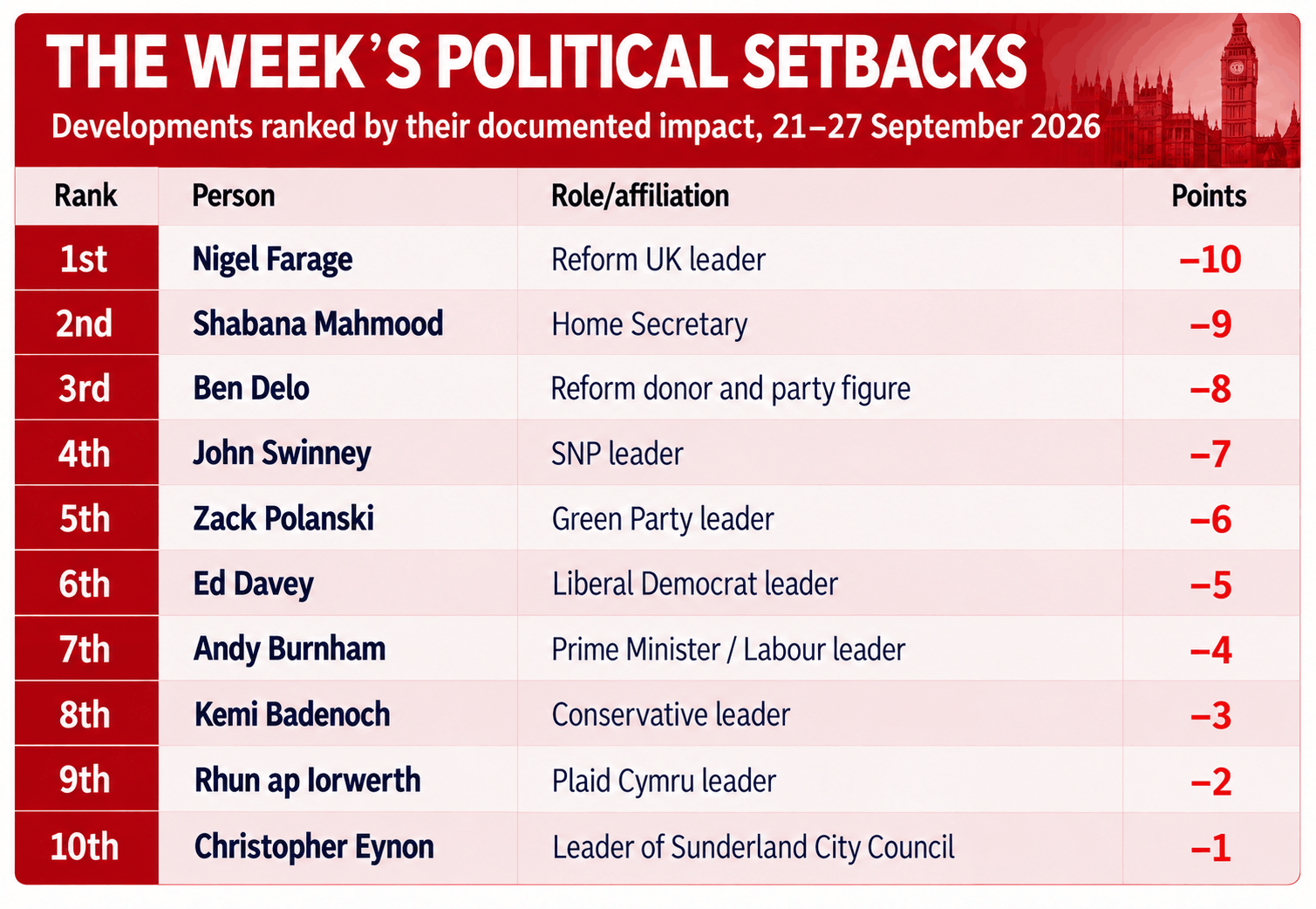
-10pts — Nigel Farage
More in Common’s MRP cut Reform’s projection from 293 seats to 147 since July. YouGov put Reform at 21%, down two points, its lowest tracker result since January 2025.
-9pts — Shabana Mahmood
Her settlement proposals faced opposition from more than 100 Labour MPs, unions and cabinet colleague Angela Rayner, who publicly called the retrospective effect on care workers disruptive and unfair.
-8pts — Ben Delo
Fresh scrutiny focused on whether his UK electoral registration met residency requirements while he lived in Hong Kong. Delo maintains that he complied with the law; there is no finding that his donation was unlawful.
-7pts — John Swinney
More in Common projected the SNP falling from 37 Scottish seats in July to 27, with Labour gaining substantially.
-6pts — Zack Polanski
Despite the favourable YouGov poll, More in Common projected the Greens on three seats, down seven from July, illustrating a significant parliamentary-projection setback.
-5pts — Ed Davey
Conference exposed a significant strategic argument over whether the Liberal Democrats should build a coherent national identity or focus primarily on targeted anti-Reform tactical campaigning.
-4pts — Andy Burnham
Labour’s flagship foundation-apprenticeship scheme had recorded 160 starts in eight months, against a target of 30,000 by the end of parliament. The Guardian
-3pts – Kemi Badenoch
Opinium separately recorded Conservative voting intention falling from 18% to 17%, showing that the week’s polling evidence was mixed rather than uniformly favourable. Opinium
Rhun ap Iorwerth and Christopher Eynon complete the adverse board
More in Common’s MRP projected Plaid Cymru at six seats, down three from July. (Rhun ap Iorwerth, -2pts)
Reform-led Sunderland council’s withdrawal of long-running support for Show Racism the Red Card generated significant criticism from the charity, local figures and opponents. (Christopher Eynon, -1pt)
Week #2 — Political Impact Table
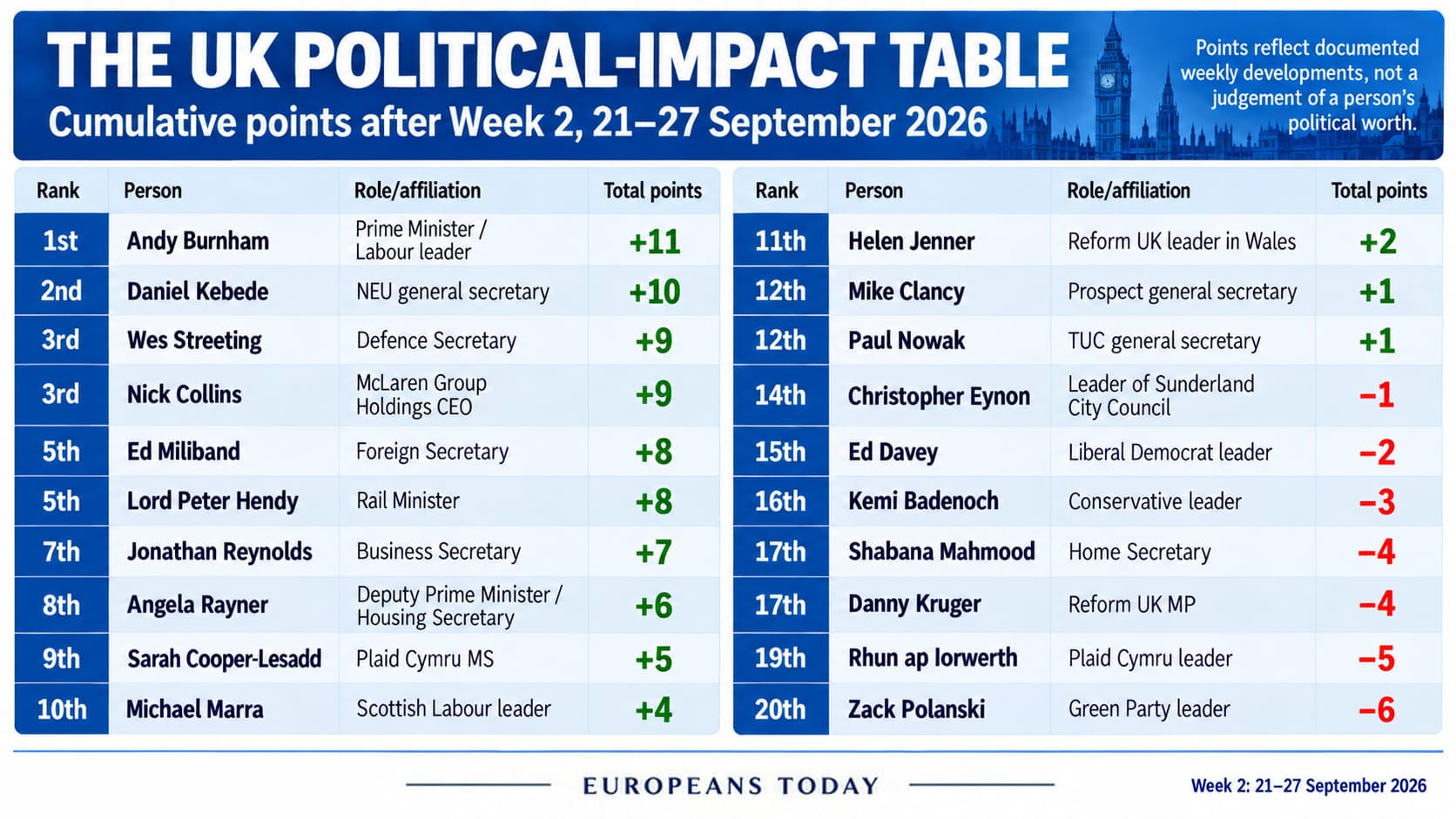
XTRA | How the Political-Impact Table works
The two weekly boards generate the points used in the cumulative table.
A first-place favourable development is worth +10, second place +9 and so on until tenth place receives +1.
A first-place adverse development is worth −10, second place −9 and so on until tenth place receives −1.
If someone appears on both boards, both scores count.
For example, Rhun ap Iorwerth receives +6 from the favourable board and −1 from the adverse board this week, producing a net Week 1 score of +5.
Zack Polanski receives +3 and −3, producing a net score of 0.
The calculation in future editions will be:
New total points = previous cumulative total + this week’s net change.
The tracker is open-ended. Scores will continue accumulating for as long as the series runs rather than automatically expiring after 26 or 52 weeks.
This makes it possible to see whether a person repeatedly accumulates significant favourable developments, adverse developments, or a mixture of both over a prolonged period.
METHODOLOGY
Before assigning the weekly scores, Europeans TODAY searches broadly across official government and parliamentary material, regulators, courts, polling organisations, political parties, trade unions, businesses and major independent news organisations.
Potential entrants are then reviewed individually. That review can include policy delivery, elections, appointments, resignations, defections, court or regulatory action, polling, interviews, speeches, press conferences, business decisions, scandals, investigations, favourable and adverse coverage, public interventions and expert analysis.
Visibility also matters. A highly prominent story can have substantial political impact even without an immediate institutional decision. We therefore consider the breadth, duration and intensity of coverage, together with measurable public reaction where evidence is available.
However, repeated articles about the same event do not generate separate points. They are consolidated into a single underlying development.
Polling is treated cautiously. Small movements rarely justify large scores, and multiple polls showing essentially the same change are considered collectively rather than being stacked as separate developments.
Allegations, investigations, charges and convictions are treated as different categories. An investigation is never presented as proof of guilt. Party-level consequences are also distinguished from evidence of personal responsibility.
The weekly positions therefore represent an editorial assessment of the documented political significance of developments, using a consistent points framework. They are not ratings of personal competence, character or political desirability.
Follow our UK Political-Impact Tracker every week for the latest favourable developments, adverse developments and cumulative political-impact scores.

GOING FURTHER
- More In Common: September 2026 MRP
- YouGov: Voting intention, 20–21 September 2026
- Opinium: Voting intention, 23 September 2026
- GOV.UK: Work and training placements for young people
- GOV.UK: Prime Minister’s UN General Assembly speech
- GOV.UK: £210m high-street regeneration package
- Financial Times: Liberal Democrat income-tax proposal
- The Guardian: refugee resettlement routes; care-worker visa dispute; Liberal Democrat strategy debate; foundation apprenticeships; Sunderland council and Show Racism the Red Card
- Prospect: MOD pledge on youth work opportunities
- ITVX: Reform UK leadership in Wales; The Times: Ben Delo electoral-registration scrutiny
Sources:
▪ This piece was first published in Europeans TODAY on 28 September 2026.
▪ Cover: Dreamstime/KORWEN.